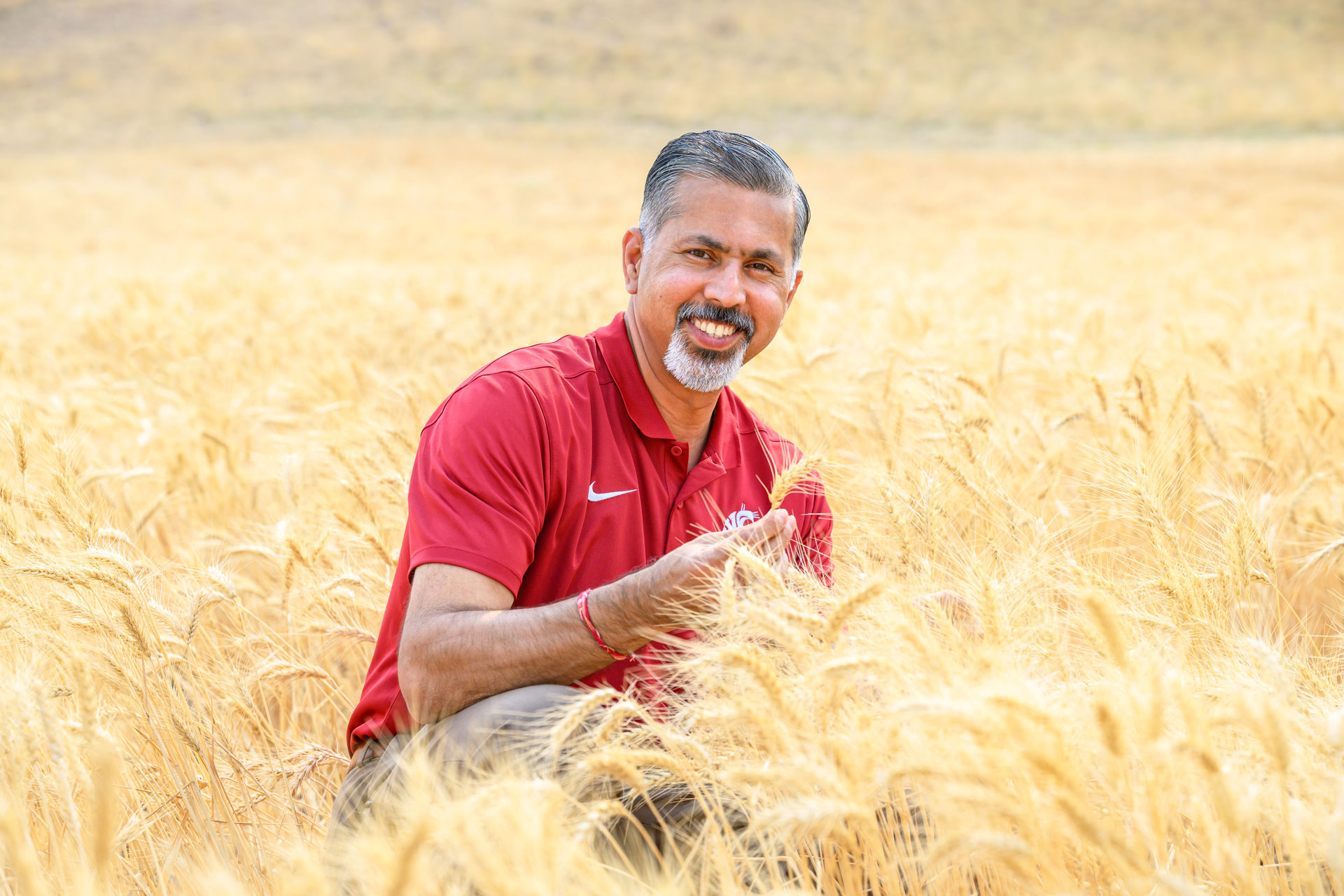
Raj Khosla
Joining CAHNRS on Sept. 1, 2025, Raj Khosla is a globally recognized expert on precision agriculture, an experienced academic leader, and an award-winning scientist and educator.
Khosla comes to Washington State University from the Department of Agronomy at Kansas State University, where, as department head, he led state-spanning research, education, and Extension outreach across multiple business/service units and disciplines, including crop sciences – plant breeding and genetics; weed science and management; range and forage science; soil science; and climatology – meteorology.
Khosla grew up in a humble environment surrounded by inequities, in a family with strong ties to farming who were uprooted from their land and dwellings due to the country’s partition and forced to migrate south. Khosla is a proud product of land grant institutions and is grateful to his teachers and mentors who saw potential in him to pursue advanced studies. He was the first in his family who was sent to college to study agricultural sciences.
Khosla received his bachelor’s degree in agricultural sciences from the University of Allahabad, India followed by a master’s degree in soil physics and a doctorate in soil fertility and crop management at Virginia Tech, respectively. He served as faculty at Colorado State University, holding the distinguished University Monfort Professorship and being named the Robert E. Gardner Professor of Precision Agriculture. He also served as the Assistant Dean for International Research Programs at Colorado State’s College of Agricultural Sciences, prior to serving as the Head of the Department at Kansas State University.
As a scientist, Khosla focuses on use of spatial and temporal variability in agro-ecosystems to improve management decisions for producers, enhancing production, resource efficiency, and sustainability. His distinguished scientific career includes more than two decades of contributions to precision agriculture, including founding and serving as past president of the International Society of Precision Agriculture.
His contributions have drawn more than 50 awards and honors, including the Werner L. Nelson Award for Diagnosis of Yield-Limiting Factors from the American Society of Agronomy. Khosla was named Precision Agriculture Educator of the Year in 2015 and honored as a Jefferson Science Fellow by the National Academy of Sciences in 2012.
Khosla has delivered over 200 invited scientific presentations in over 30 countries, including two congressional briefings on Capitol Hill in Washington, D.C., and numerous opening keynotes at major scientific conferences globally.
His expertise has informed national and international agricultural policy through roles such as Senior Science Advisor on Food Security to the U.S. Department of State and a two-term member of the U.S. Presidential Advisory Board on Positioning, Navigation, and Timing for NASA. He is a Fellow of seven scientific societies, including the American Association for the Advancement of Science, American Society of Agronomy, Soil Science Society of America, and the Crop Science Society of America.
About the Cashup Davis Endowed Deanship
Established in 2018 by CAHNRS alumnus Gordon Davis, the deanship supports academic and research endeavors that reflect the Davis family’s visionary, entrepreneurial spirit. Made possible by a $5 million gift from Mr. Davis, the program was the first endowed deanship at WSU, creating opportunities that meet the needs of our students and adapt new solutions for agriculture across our state and around the globe.
The endowment helps CAHNRS leaders build a culture of philanthropy among university alumni and partners as well as students. The college recognizes outstanding students embodying the Davis family’s values through the Cashup Davis Merit in Agricultural & Natural Resource Sciences and Cashup Davis Merit in Human Sciences Awards.

Vicki McCracken
Associate Dean & Director, Extension
Vicki A. McCracken is a professor in the School of Economic Sciences at Washington State University and is the previous chair of the Department of Apparel, Merchandising, Design, and Textiles. She received her undergraduate degree from Indiana University with dual majors in economics and home economics (human nutrition track), and completed her master’s and doctorate at the rival Purdue University in agricultural economics. She has spent her entire career since 1984 at WSU, serving as a faculty member and in various administrative leadership positions.
She has taught courses in quantitative methods, intermediate micro, and applied marketing and price analysis. Her research and Extension interests are broad-based, ranging from analysis of social and economic issues of importance in agricultural production contexts to alternative agricultural markets and human health to identifying determinants of student academic success. McCracken has a steady stream of external grant funding that has supported her research, resulting in continuous conference presentations and publications.
McCracken has been active in service throughout her career. She has wide-ranging committee service at WSU and for the agricultural economics profession. She has been honored with awards and leadership positions from numerous organizations, including National Research Initiative: Markets and Trade Panel Manager; W.K. Kellogg Foundation Collaborative Efforts—Partnership 2020; ESCOP/ACOP Leadership Program; Outstanding Teaching and Leadership awards at WSU; and Fellow of the Western Agricultural Economics Association.
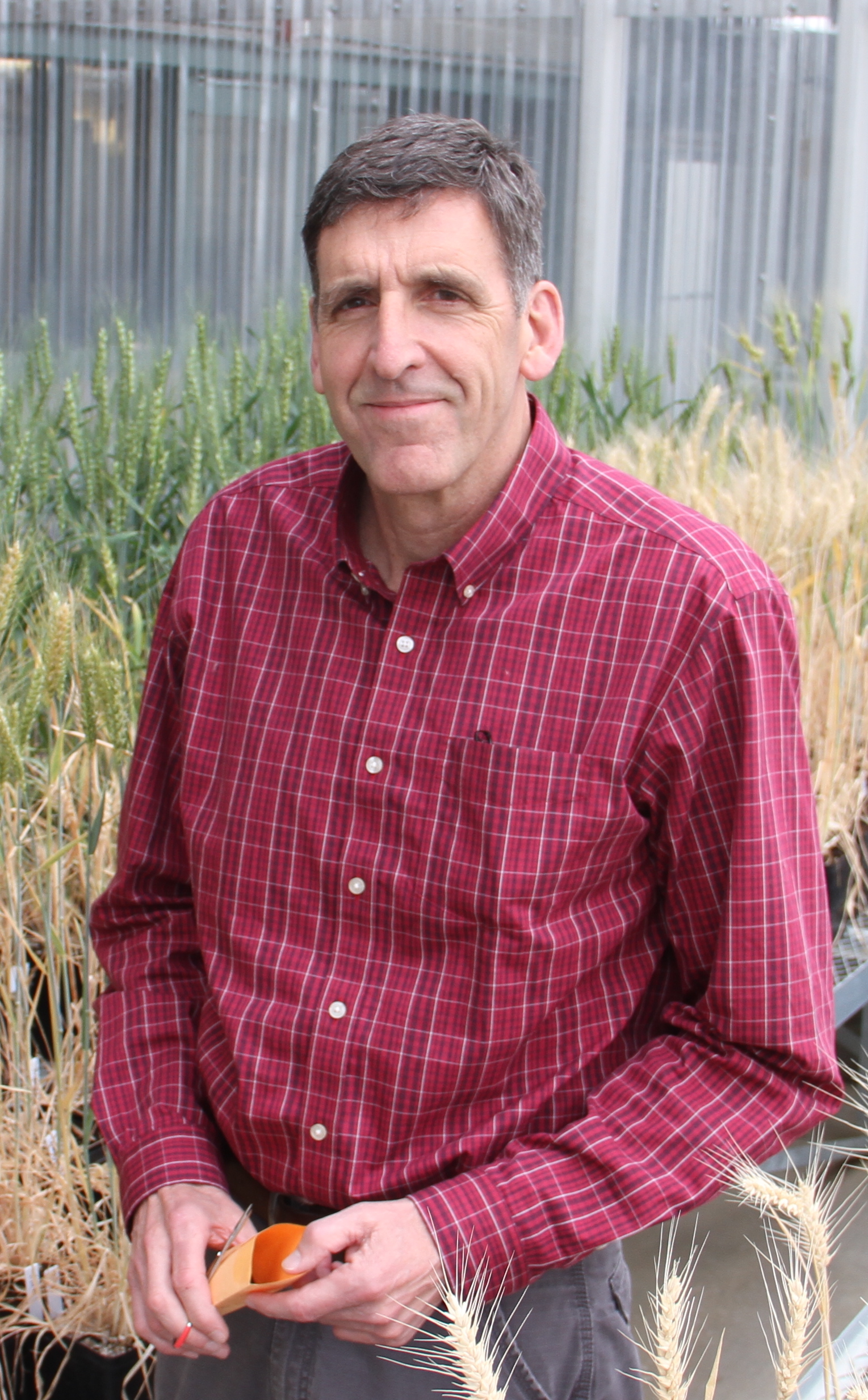
Scot Hulbert
Interim Associate Dean for Research
An alumnus who has led and supported research and education at Washington State University for nearly 20 years, Scot Hulbert is the Senior Associate Dean of Operations for CAHNRS, beginning in this role in January 2024.
Hulbert started out life on a farm in Mount Vernon, Wash., where his family grew strawberries, vegetable seed crops, daffodils, peas, and other crops. Through that experience, he was able to meet vegetable breeders and scientists at the nearby Northwestern Washington Research and Extension Center (NWREC). This led to a B.S. degree in horticulture from WSU and a Ph.D. in genetics from the University of California at Davis.
Hulbert went on to accept a two-year postdoctoral fellowship in biological sciences at Purdue University before joining the faculty of the Department of Plant Pathology at Kansas State University. At K-State, he studied the arms race between defense genes in plants and the corresponding virulence genes in bacteria and fungi.
In 2006, Hulbert returned to WSU as the R. James Cook Endowed Chair in Cropping Systems Pathology, leading research in genetic and land management approaches to controlling diseases and maintaining the productivity of farms. He continued this work after becoming chair of the Department of Plant Pathology in 2013.
Hulbert began serving as Associate Dean for Research in CAHNRS, where he led the university’s Agricultural Research Center and supervised scientific efforts college-wide toward a safe and abundant food supply, energy innovation, better health for families and communities, and strong environmental stewardship. He then began serving as Senior Associate Dean for Research, and is currently also serving as the Acting Dean until Raj Khosla joins us as the Cashup Davis Endowed Dean in September of 2025.
In 2019, Hulbert was named a WSU Regents Professor, the university’s highest faculty rank. He is also a recipient of Fellow Awards from two scientific societies, the American Society for the Advancement of Science and the American Phytopathological Society. These awards recognize his outstanding scientific contributions.

Nancy Deringer
Associate Dean of Student Success & Academic Programs
Nancy Deringer is the associate dean for Student Success and Academic Programs, an associate professor and principal investigator (PI) for the USDA-NIFA Federally Recognized Tribes Extension Program (FRTEP)—Kalispel Tribe; and PI for the USDA-NIFA Children, Youth, Families At-Risk (CYFAR) Dive4TECH—Juntos 4-H program at Washington State University. Deringer was a national USDA-NIFA CYFAR coach for five years and also the statewide evaluator for the University of Idaho’s CYFAR 4-H Afterschool program for four years. Previous to her role at WSU, Deringer was tenured academic faculty at the University of Idaho’s School of Family and Consumer Sciences for ten years, and prior to this, associate director for the Center on Disabilities and Human Development (CDHD) for ten years. The CDHD is a University Center on Excellence for Developmental Disabilities (UCEDD), funded by the United States Department of Health and Human Services. Deringer’s focus is reaching and engaging underrepresented youth and families through innovative programming. She has acquired over $14 million in grants and contracts from foundation, state, and federal sources. Deringer’s research area of interest is examining family socialization and financial literacy among youth and young adults, especially those who are first generation or from underrepresented groups.