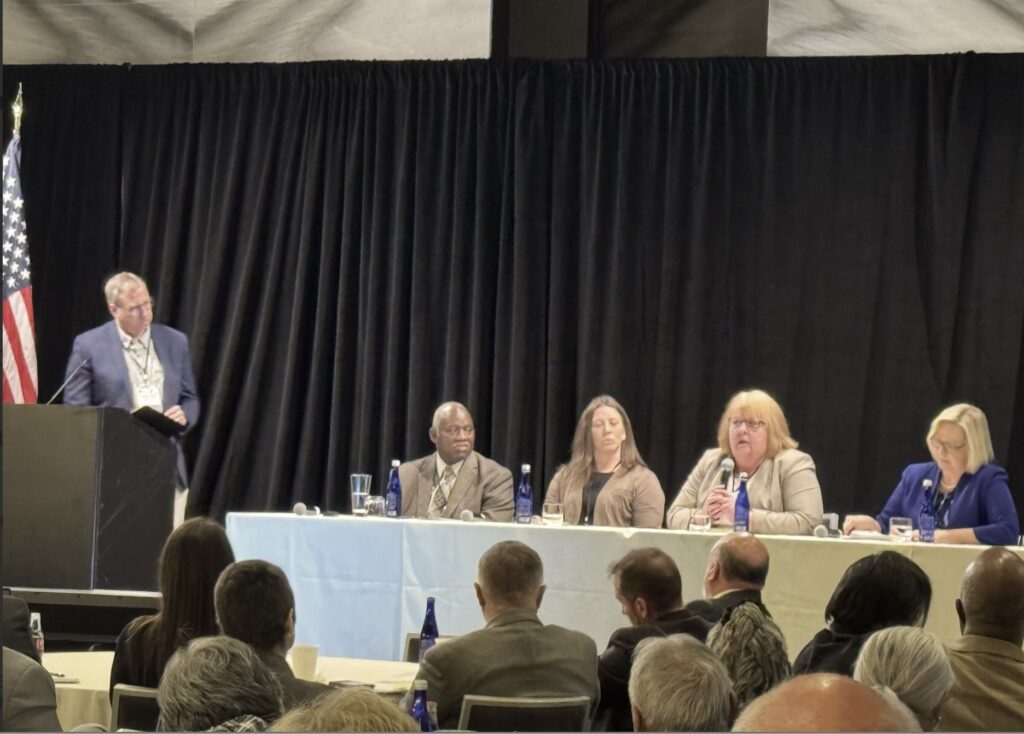
Delegates representing CAHNRS and Washington state food and agriculture joined Wendy Powers, the Cashup Davis Family Endowed Dean of CAHNRS, and colleagues from across the nation at a conference in Washington, D.C., that shares and supports the priorities of the land-grant university system.
On Feb. 23-24, one of three CAHNRS delegates to the Council for Agricultural Research, Extension, and Teaching (CARET), a program of the Association of Public and Land-grant Universities’ Council, met peers from APLU’s Board on Agriculture Assembly (BAA) during the 2025 CARET/BAA Washington Conference.
Capitol Hill visit highlights research impacts
Dean Powers, CAHNRS Advisory Council member and CARET delegate Mike Miller, and Associate Dean for Research Leslie Edgar shared impacts made by CAHNRS scientists and educators during a visit to Capitol Hill in Washington, D.C., Feb. 25-26, 2025.
College representatives met legislators and discussed the impacts of WSU research on Northwest agriculture as well as the value of ongoing support for innovation and workforce development.
“CAHNRS is grateful for the time and commitment made by our CARET members,” Powers said. “While we at WSU can set the stage for conversations, it is the personal stories of impact shared by our CARET representatives that resonate and are remembered by legislators. For this reason, our college aims to support a team of CARET members who can speak to the breadth of CAHNRS programs and represent the beneficiaries of these programs from districts across the state.”
CAHNRS CARET representatives
CARET is a national volunteer organization that supports land-grant food and agricultural research, extension, and teaching programs, helping enhance quality of life for all people.
Our college’s CARET delegates include three members of the CAHNRS Advisory Council, a group of community and industry stakeholders who help inform our land-grant mission.
Mike Miller
A fourth-generation Washington state farmer raising wheat, cattle, potatoes, and alfalfa near Ritzville, Washington, Mike Miller is a founder and co-owner of Washington Genetics LLC, a marketing and consulting company serving universities, municipalities, commodity groups, government agencies, and the food security network.
Miller has served on local, state, national, and international committees for more than 40 years. A strong advocate for agriculture and the food, feed, and fiber industries, he represents the college as a CARET member and Western Chair and as a budget committee liaison to APLU’s executive board.
“My background allows me to carry the overall APLU-CARET message from industry members and farmers, many of whom depend on land-grant support in their daily jobs, to agencies and legislators,” Miller said. “It becomes a conversation between parties about why research, xtension, and teaching matter to industry and growers, and how they impact the food chain all the way up to the consumer.”
Sandra Brown
Sandra Brown is a retired Clark County Extension consumer food safety expert and nutrition faculty member. During a 37-year career at WSU, she led nutrition education programs serving low-income families and school children, directed diabetes education and other research and outreach programs, and was active in her professional organization, the Association of Extension Home Economists.
Today, Brown remains involved with Clark County as a Public Health Advisory Council member. She also serves on the Clark County Heritage Farm Advisory Board, the Friends of the Heritage Farm Foundation, the Clark County Food System Council, and as a 4-H Food Preservation leader.
As a CARET representative, Brown’s focus is health, wellness, food safety, and nutrition.
“I am interested in making sure there is federal and local support for agriculture and local food access,” she said. “Safe, plentiful food access is important for a healthy community and country. It helps reduce health care costs and strengthens the economy through active, productive citizens.”
Madison Roy
CAHNRS alumna Madison Roy is an agricultural economist with the Washington State Department of Agriculture who works to support viable agriculture and food businesses. From a fifth-generation wheat farming family in eastern Washington, Roy previously worked in production agriculture and as a research economist at Pacific Northwest National Laboratory, where she focused on energy, water, and natural resources. She holds a bachelor’s degree from WSU’s School of Economic Sciences as well as a master’s degree from the University of Idaho.