Over the last two weeks I was reminded over and over again of the incredible capacity, momentum, and dedication for state-serving research, education, and partnerships in CAHNRS. My travels from Washington, DC, to Kentucky, to communities across our own state, offered a powerful picture of who we are and what we can achieve together.
I began February 23-24 in Washington, DC, attending the Association of Public and Land-grant Universities‘ annual Board on Agriculture Assembly (BAA) meetings. The BAA meetings brought together deans and associate deans from more than 70 member institutions to deliberate on our collective priorities for congressional support.
As a group, the BAA’s efforts make a big impact. To give an example, the BAA successfully advocated over $1 billion in congressional funding to address the huge deferred maintenance backlog facing the nation’s land-grant institutions. This shows what coordinated and collective leadership can achieve. Here at WSU, the deferred maintenance gap for CAHNRS alone exceeds $600 million. With over 100 years of our legacy, infrastructure in many places is simply getting older, and new construction, while very beneficial, does not cover the gap. A Notice of Funding Opportunity (NOFO) to a tune of $125 million in federal support, matched one-to-one with state or institutional dollars, will soon be released. I have asked CAHNRS chairs and directors to propose projects that will meaningfully strengthen our research infrastructure. When we succeed, we will have essentially doubled our dollars for critical projects.
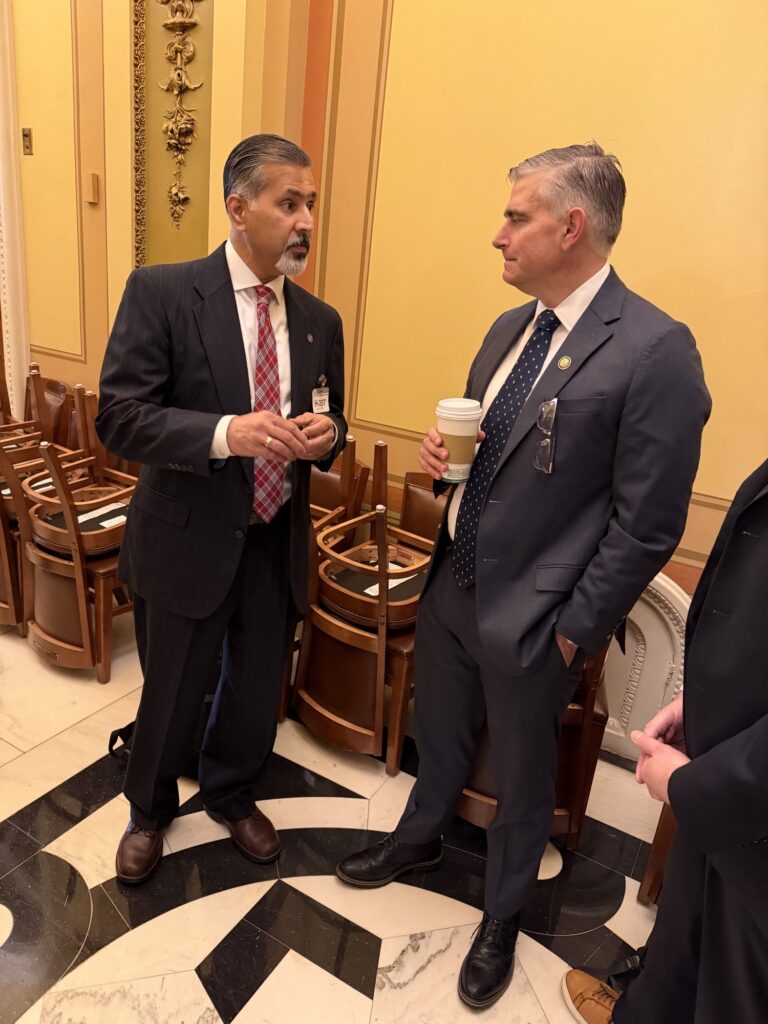
While in DC, I joined over 40 APLU Western Region institutional members on Capitol Hill to meet with our respective US representatives and senators. I had productive conversations with 4th District Rep. Dan Newhouse and 5th District Rep. Michael Baumgartner as well as legislative staff from four additional congressional offices. We emphasized the Hatch, Smith-Lever, and McIntire-Stennis capacity funds that allow us to respond rapidly to pests, pathogens, and other emerging challenges, or support a new technology. These funds are matched by the state and our institution. I was delighted by the strong support for sustaining these vital resources.
I was also proud to have Mike Miller, a fourth generation Washington farmer and one of our Council for Agricultural Research, Extension, and Teaching (CARET) delegates, join us in DC to share his perspectives. Hearing directly from stakeholders remains essential in demonstrating the real‑world impact of WSU’s work. Thank you to Mike for your instrumental partnership and support!
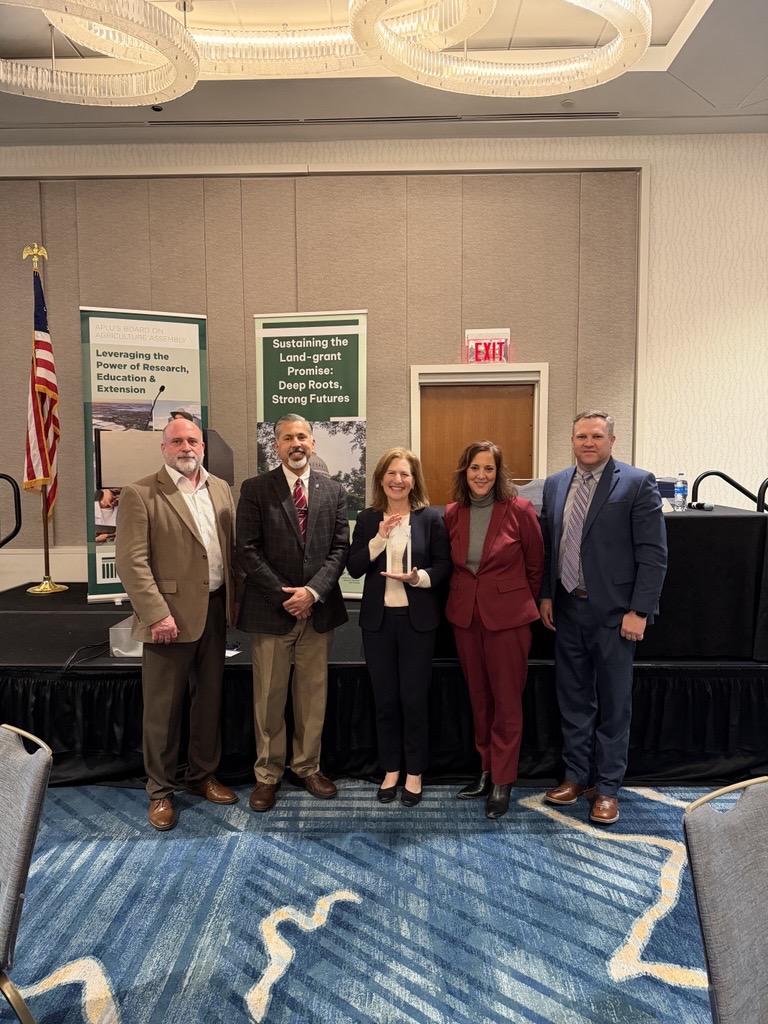
As part of the DC visit, I was joined by WSU Vice President for External Affairs and Government Relations Glynda Becker-Fenter, WSU Director of Federal Relations Jake Dowd, and Mike Miller, CARET representative, in presenting US Rep. Kim Schrier, M.D. (WA‑8) with the Meritorious Service Award to CARET. This award recognizes her leadership in advancing the Research Facilities Act and her longstanding commitment to supporting the land‑grant mission. Congratulations to Representative Schrier, and sincere thanks for her continued partnership and advocacy.
While in DC, I also met with Dr. Scott Hutchins, U.S. Department of Agriculture Under Secretary for Research, Education, and Economics. We talked about the crucial, continuing collaboration between USDA and WSU. I thanked him for supporting the new USDA-ARS Plant Sciences Building coming online this year at Pullman and extended a welcome to Pullman to celebrate its opening.
On February 25, I joined Laura Bartley, faculty member in the Institute of Biological Chemistry, along with David Gang, Manuel Garcia-Perez, and others in Lexington, Kentucky, for a National Science Foundation (NSF) site visit. CAHNRS is part of a four-institution team, led by the University of Kentucky, that is competing for $30-million in NSF funding for a new Engineering Research Center. It was important to demonstrate the strong institutional support behind projects of this scale, and I remain deeply committed to championing our faculty in all initiatives.
Back in Washington state, I met with Washington Farm Bureau CEO Brody Miller and Communications Director Bailey Moon. I have enjoyed working closely with Farm Bureau and earning their support at past institutions, and I am committed to renewing and strengthening that partnership here. This was a very synergistic meeting, and I look forward to collaborating and partnering together.
On March 3, I visited with Extension Environment and Community Outreach Specialist Patricia Townsend to learn about Climate Stewards at the King County Extension office. This exciting new program engages urban and rural residents of Island, Skagit, and Whatcom Counties in learning approaches to aid our environment at the local and regional level. The next cohort begins in April. I also had a great exchange with Alyssa Bowers, King County Extension director, and Diane Smith, a longtime Extension faculty member and nutrition educator based in Skagit County.
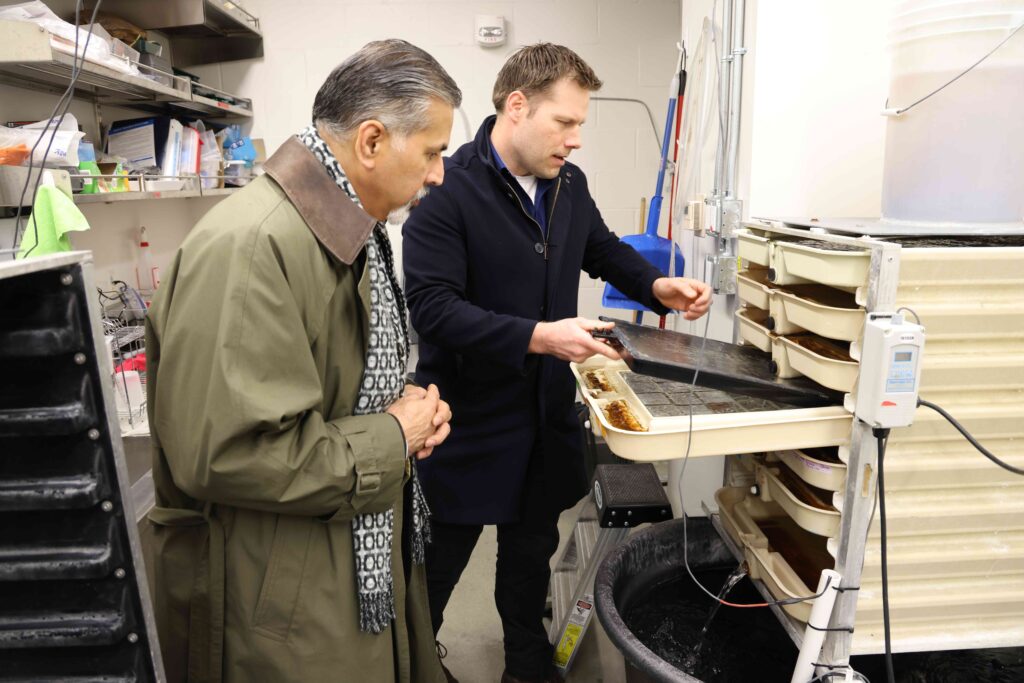
On March 4, I toured the Department of Animal Sciences, viewing in-person some of the exciting work taking place in this phenomenally talented department. I toured laboratories in the state-of-the-art Veterinary and Biomedical Research Building, where world-class faculty like Regents Professor Min Du, Assistant Professor Michael Phelps, and others are advancing our fundamental understanding of animal physiology, nutrition, and genetics. Dr. Phelps walked me through research on salmon and rainbow trout, and we visited his chicken coop-turned-fish-hatchery at the Carver Farm. The future of animal sciences is bright as it continues to grow. Three impressive early-career faculty—Addison Carroll, Zachary Seekford, and Kim Davenport—were recently hired, and additional searches are underway for three assistant professors to bolster their ranks.
On March 5, I took part in an exit interview with accreditors from the Society of American Foresters visiting the School of the Environment. WSU’s Forest Ecology and Management program has operated under provisional accreditation for the past 10 years and is now earning formal accreditation. Our visitors noted the program’s collaborative and energetic faculty, increasing enrollment, strong curriculum and support staff, complimentary students, and opportunities for growth in forest operations and economics. Overall, this was a very positive experience. My thanks to Assistant Professor Austin Himes for his leadership of the program and support of the process.
I close with a few reflections on the proclamation of March as Washington Agriculture Month. Communities across the state will also observe National Agriculture Week March 15-21 and National Agriculture Day on Tuesday, March 24. It’s an important moment to honor agriculture’s vital contributions to Washington’s economy, communities, and future. As WSU’s ag-serving college, this is our time to celebrate! We must recognize all the teamwork and hard effort that goes into our college’s mission every day. No success is too small or too large—every accomplishment matters, and our collective achievements are always greater than the sum of their parts. Together, we can go far! Happy Ag Month and National Ag Day to everyone! Please join us on March 24 on the Terrell Mall at WSU Pullman from 10 a.m. to 2 p.m. for activities, giveaways, and celebrations in honor of National Agriculture Day, as we recognize agriculture’s vital role in our state and celebrate our strong legacy and bright future.
Kudos Corner
Congratulations to Zhiwu Zhang, professor in the Department of Crop and Soil Sciences, who is part of the first cohort of the National Science Foundation’s AI-ENGAGE initiative. Dr. Zhang received a $400,000 grant to develop a new, open-source computer system that can process vast amounts of complex data, ultimately serving the breeding of higher-yielding wheat crops.
Kudos to Amin Kandelati, doctoral student in the Department of Biological Systems Engineering. He has received an INSPIRE! Graduate Student Community Engaged Research Grant of nearly $5,500 for his project, “Moving from Agricultural Conservation Practice Adoption to Environmental Benefits: Co-developing Research Methods and Metrics.”
Congratulations to Silas Bossert, assistant professor in the Department of Entomology, for his latest achievement, identifying and describing a new species of bee. This discovery is newly published in the Journal of Melittology, and I am excited to see this newly described species join the M.T. James Collection at WSU.
Until next time, Go Cougs!
Sincerely,
Raj