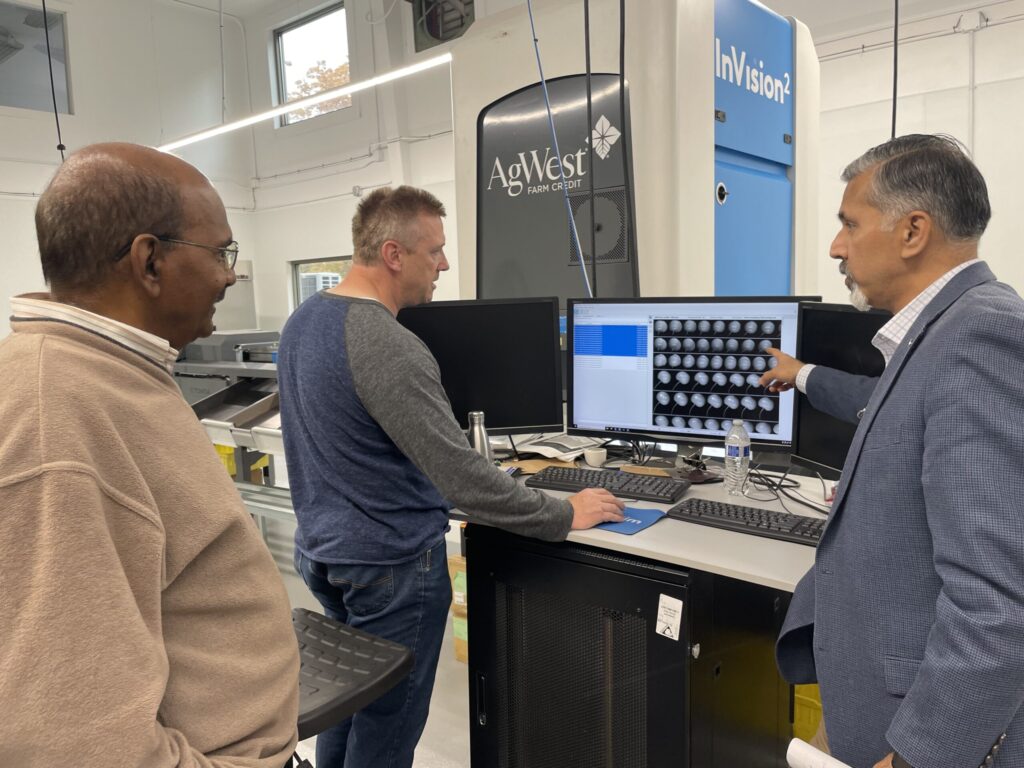
Sixty days into my role, I have had the privilege of witnessing firsthand the depth of collaboration and partnerships that define CAHNRS—within our college and across institutional and industry boundaries. While we have sometimes been characterized as operating in silos, what I have seen so far across our units is quite the opposite. I continue to be inspired by the ways our faculty, students, and staff are bridging disciplines and working in concert to advance our mission and serve stakeholders across Washington and beyond.
During my visit to the Irrigated Agriculture Research and Extension Center (IAREC) in Prosser, I met CAHNRS faculty from the Departments of Horticulture, Crop and Soil Sciences, Entomology, Plant Pathology, Viticulture and Enology, Biological Systems Engineering; the School of Food Science; WSU Extension Agriculture and Natural Resources; and other units working alongside our partners from USDA and the Washington State Department of Agriculture. The entire team of faculty, postdoctoral fellows, graduate students, staff, and farm employees is working seamlessly on a common mission—addressing complex challenges facing our tree fruit industry, wine sector, and irrigated agriculture. IAREC stands as a compelling example of integrated, cross-disciplinary, collaborative practice—a transformation that reflects our commitment to cross-functional engagement with shared purpose.
Similarly, in a reception and in-depth conversation with members of the Washington wine industry, it became clear that wine growers view CAHNRS units, USDA, and state partners not as separate entities, but as a cohesive ecosystem. Their challenges, whether related to soil fertility, disease management, or market dynamics, are interconnected, and they seek comprehensive, systems-level solutions. We are delivering exactly that. It is a reflection of our collaborative strength and a source of pride for our college.
Last week, I learned how an industrial-scale biodigester turns dairy waste into useful, renewable energy, as part of a tour of Werkhoven Dairy in Monroe, Washington led by the Washington State Dairy Federation. Thanks to market demand for sustainably produced milk, interest in biodigester technology is increasing. CAHNRS is responding with a small-scale biodigester, funded by the Dairy Federation and the Washington State Legislature and expected to be operational by December 2026 at Knott Dairy Farm. The new biodigester will become a critical part of our Pullman research, teaching, and outreach infrastructure, educating the next generation of leaders to sustain and innovate within Washington’s dairy industry.
I also had the honor of attending the Washington Research Foundation (WRF) reception at the Museum of History & Industry in Seattle. WRF has funded our new $10 million BioInnovation Grant that anchors a broader $19 million WSU initiative to establish the Center for Health, Environment, Food and Farming. This transdisciplinary project builds on our Soil to Society program to develop new crop varieties for farmers and promote whole grains in school lunchrooms and diets statewide. I am so grateful to the WRF, the Washington Grain Commission, and other supporters for making real these beneficial, multidisciplinary advances for growers, farm businesses, and public health.
At Pullman, I met with the members of the Land Legacy Council as well as the Apparel, Merchandising, Design, and Textiles Advisory Board, and participated in the Hatch Umbrella Retreat. There I observed thought-provoking presentations from graduate students on their ongoing research and had the opportunity to address students, postdocs, and faculty from the Institute of Biological Chemistry, Department of Plant Pathology, and Department of Crop and Soil Sciences.
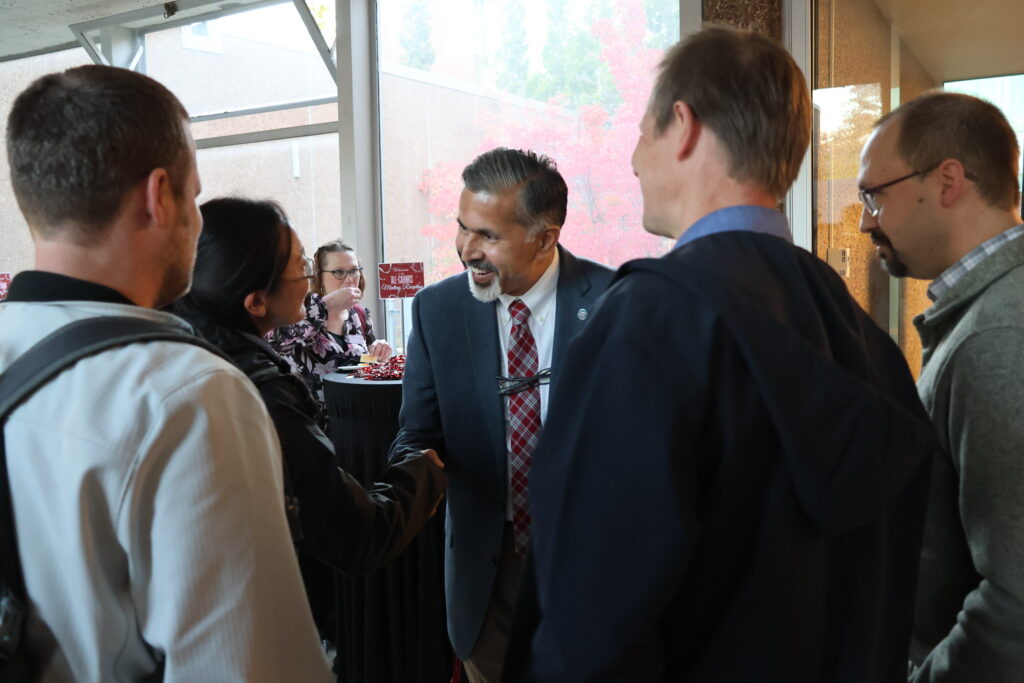
One of the highlights of the past month was the All-CAHNRS Faculty and Staff Meeting where roughly 200 members of our college came together. It is my intention that such gatherings serve as a direct channel for updates from your dean and associate deans, fostering transparency in our operations and planning. At the reception that followed, I saw new connections forming: colleagues meeting for the first time, discussing ideas, and exploring opportunities for collaboration. These moments are the seeds for future partnerships and in a college as diverse as CAHNRS, we must cultivate them regularly—and we will!
I look forward to continuing these conversations at our upcoming CAHNRS Town Hall Meeting, scheduled for 3 p.m. Friday, December 5, at Johnson Hall Annex C107 and online via Zoom. I hope to see many of you there as we build on this momentum together.
Until next time, Go Cougs!
Sincerely,
Raj