Welcome back to campus after spring break. We hope the week offered time to rest, reflect, and recharge. As we return, it is heartening to see the seasonal change across the Palouse—the fields are greening and daffodils are blooming, signaling renewal and opportunity. We are glad to have you back and look forward to the energy and momentum you bring as we move confidently toward a successful and fulfilling spring semester.
Over the past two weeks, I have been on the road—listening, learning, and seeing firsthand the remarkable impact CAHNRS is delivering in partnership with agricultural producers and communities across Washington. Everywhere I went, one theme stood out: When we work together, our reach and relevance grow.
On March 9, I had a productive conversation with my University of Idaho counterpart, Dean Leslie Edgar of the College of Agricultural and Life Sciences, and we both came away with the desire to work more closely together. We plan to identify collaborations that build on the complementary strengths of our institutions.
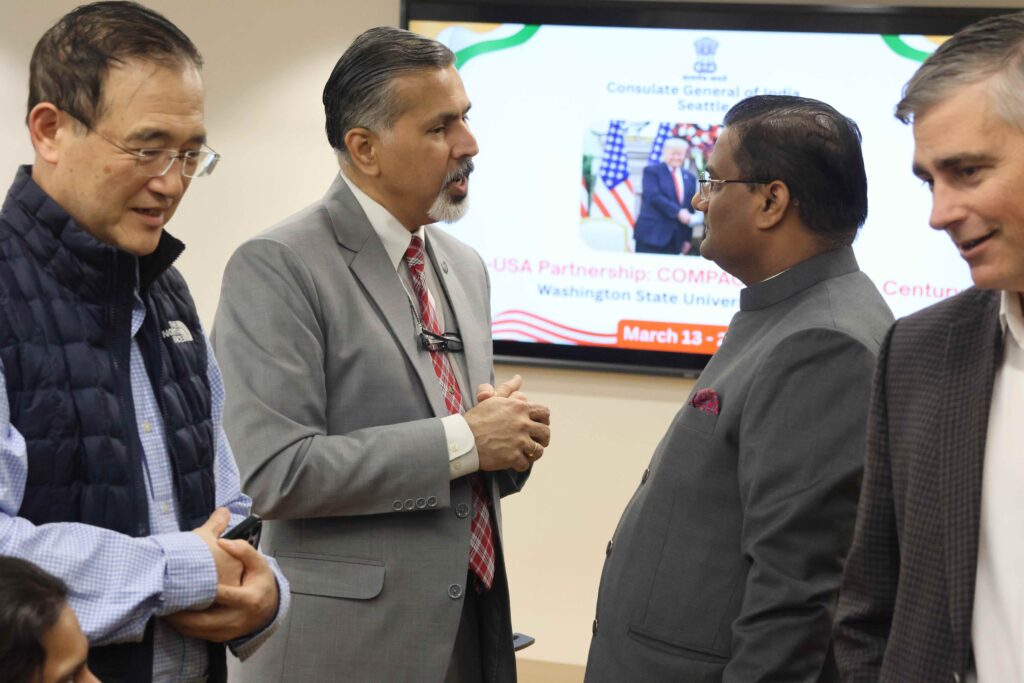
On March 13, I joined Prakash Gupta, the inaugural Seattle-based Consul General of India, and 5th District Rep. Michael Baumgartner, during their visit to Pullman. We highlighted CAHNRS research for members of the Indian consulate and discussed opportunities to grow research and educational exchange. In his presentation, Congressman Baumgartner highlighted that every student should consider an experience in India, emphasizing that few opportunities offer such powerful perspective and global connection.
Later in the month, I returned to the Tree Fruit Research and Extension Center in Wenatchee, where Washington’s tree fruit producers rely on us for knowledge, innovation, and solutions. Walking the orchards at Sunrise and Columbia View, visiting the original Cosmic Crisp® mother tree, and learning more about pruning, grafting, and the importance of compatible rootstocks reinforced how deeply our science is rooted in practice.
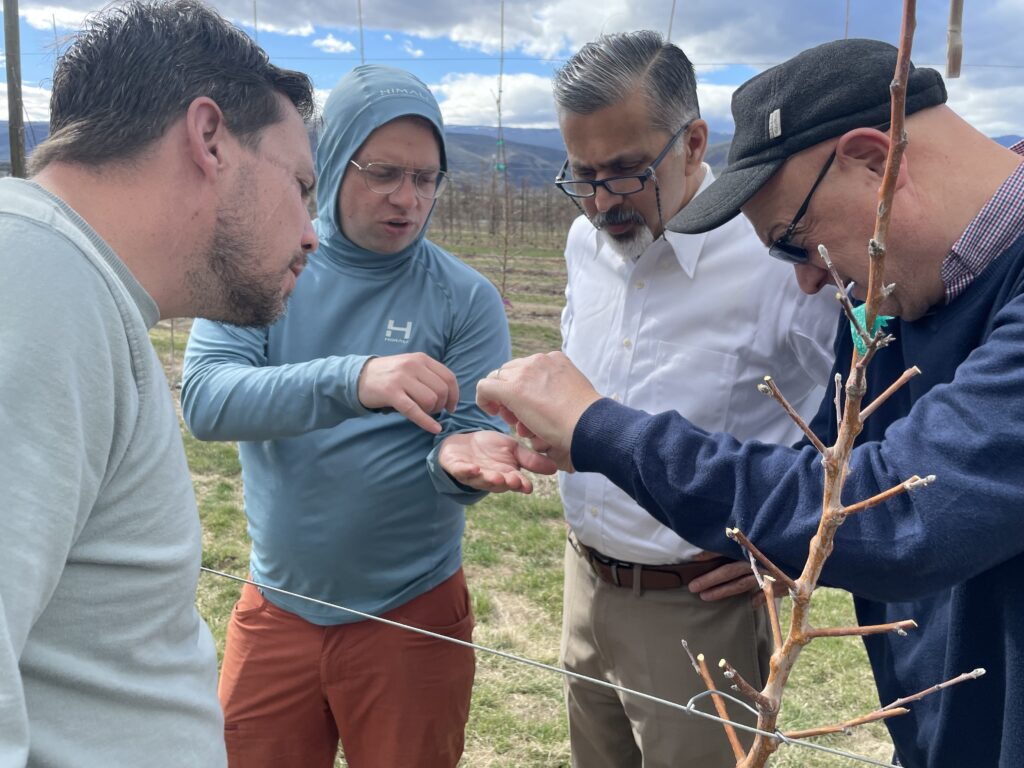
I spent the next full day listening and learning from our endowed faculty who presented their research updates and future goals to industry supporters. The five endowed faculty—with a sixth on the way—are tackling real‑world grower challenges and leveraging endowment support two‑ to ten‑fold through federal funding. I was especially impressed by their ability to translate complex science into action.
Equally important during my visit were the one‑on‑one conversations I had with faculty—tenure and career track faculty, Extension professionals, and our Information and Technology Transfer team, including five new cluster hires. The one-on-one conversations and my visit with staff members were quite insightful and rewarding. They shape our strategy in real-world experience and what we care about together.
I also had the opportunity to meet with West Mathison, president of Stemilt Growers, on March 19. During our conversation, he highlighted the rising national rank of Cosmic Crisp®, which recently hit No. 4 nationally. This a great example of what sustained research and partnership can achieve.
A prior stop in Ellensburg also brought me face to face with Extension faculty serving Kittitas and Yakima Counties, including Tipton Hudson, Patty Ratzlaff, Cheryl Reese, Alison White, Andrea Morse, and Amy Alder. I was inspired by Alison’s work reaching over 3,000 youth through 4-H, as well as Cheryl’s leadership on farm stress and suicide prevention. Her COMET program—Changing Our Mental and Emotional Trajectory—is saving lives, and it exemplifies Extension at its best.
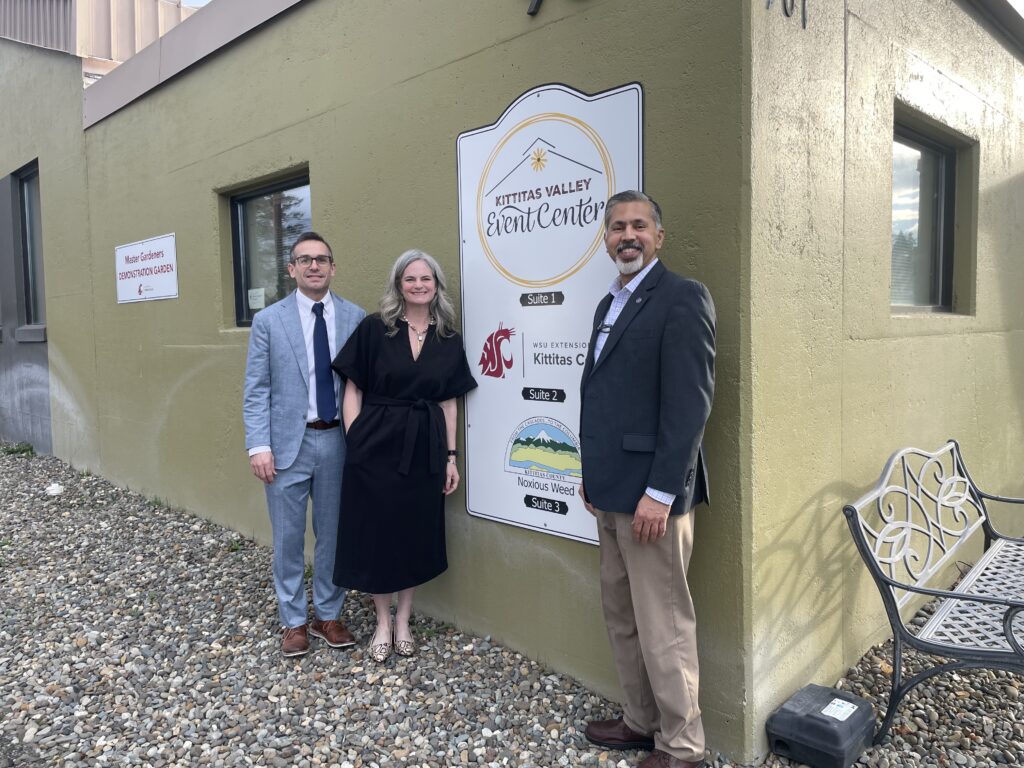
Engagement with industry and advocacy partners remains a priority. Visits with the Washington Cattlemen’s Association and the Washington Farm Bureau reinforced how closely aligned our missions are. As educators and food producers, we must continue to identify talent, support students, and speak with a collective voice to further our priorities. I was delighted to have Nancy Deringer and Judy Hopkins from CAHNRS Student Success and Academic Programs join me at the Washington Cattlemen’s Association board meeting.
As I visit more counties, I hope to meet with additional Farm Bureau members and learn how we can partner in advocacy.
I concluded my travels with my wife, Reena Khosla, at Taste Washington in downtown Seattle, alongside President Cantwell. The event highlighted the depth and excellence of Washington’s wine and culinary scene through curated tastings and educational classes. It was an exceptional, palate-pleasing way to learn about the state’s vibrant wine industry.
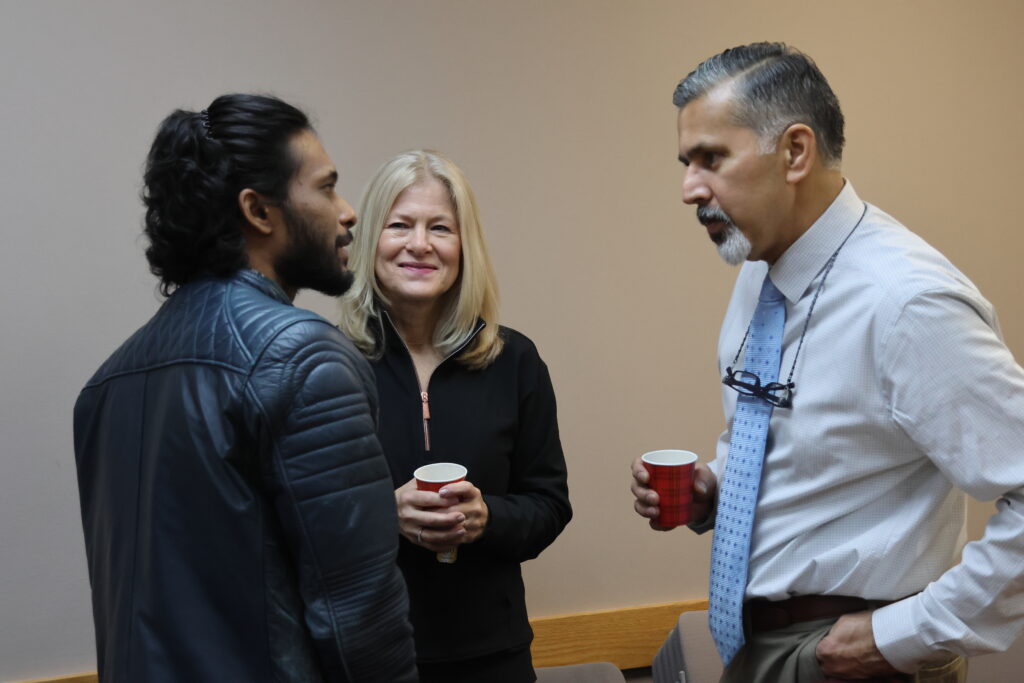
Within CAHNRS, our sense of community continues to grow. Coffee Beans with Deans has been a wonderful way to connect with faculty, staff, and graduate students. Our next session is 9 a.m. Wednesday, April 15, at 405 Lighty, along with members of the CAHNRS Advisory Board. I hope to see you there. Please join us!
Kudos Corner
Congratulations to our President’s Big Ideas Initiative Awardees! Jen McIntyre, as primary investigator, and co-PI Michael Phelps received $100,000 for research on water quality impacts to salmon health. Chris Benedict, Lav Khot, Kirti Rajagopalan, and Anna Warner are co-investigators on a $300,000 translational effort to put artificial intelligence to responsible, collaborative use by rural communities.
Sheersa Manna, doctoral student in the Department of Plant Pathology and part of the Prosser Irrigated Agriculture Research and Extension Center, has earned the competitive WSU Graduate School’s Richard R. and Constance M. Albrecht Scholarship.
Weidong Chen, adjunct in the Department of Plant Pathology and member of the USDA-ARS Grain Legume Genetics Physiology Research Unit, is a new fellow of the American Phytopathological Society. He will be honored at the group’s national meeting this August.
A junior in CAHNRS, Field Crop Management student Reed Scott, is the newly elected vice president of the Associated Students of Washington State University. He ran alongside the new student president, Grace Carpenter, in their successful election campaign.
Kory Floyd, professor and chair of the Department of Human Development, was elected a fellow of the International Association for Relationship Research. He will be inducted at the bi-annual conference this July in Scotland.
Allyson Beall King, director of the School of the Environment (SOE), earned the 2026 WSU College of Arts and Sciences (CAS) Outstanding Career Achievement Award. She will be recognized at a CAS awards reception April 9. SOE is a joint endeavor of CAHNRS and CAS.
Until next time, Go Cougs!
Sincerely,
Raj